Meshy AI
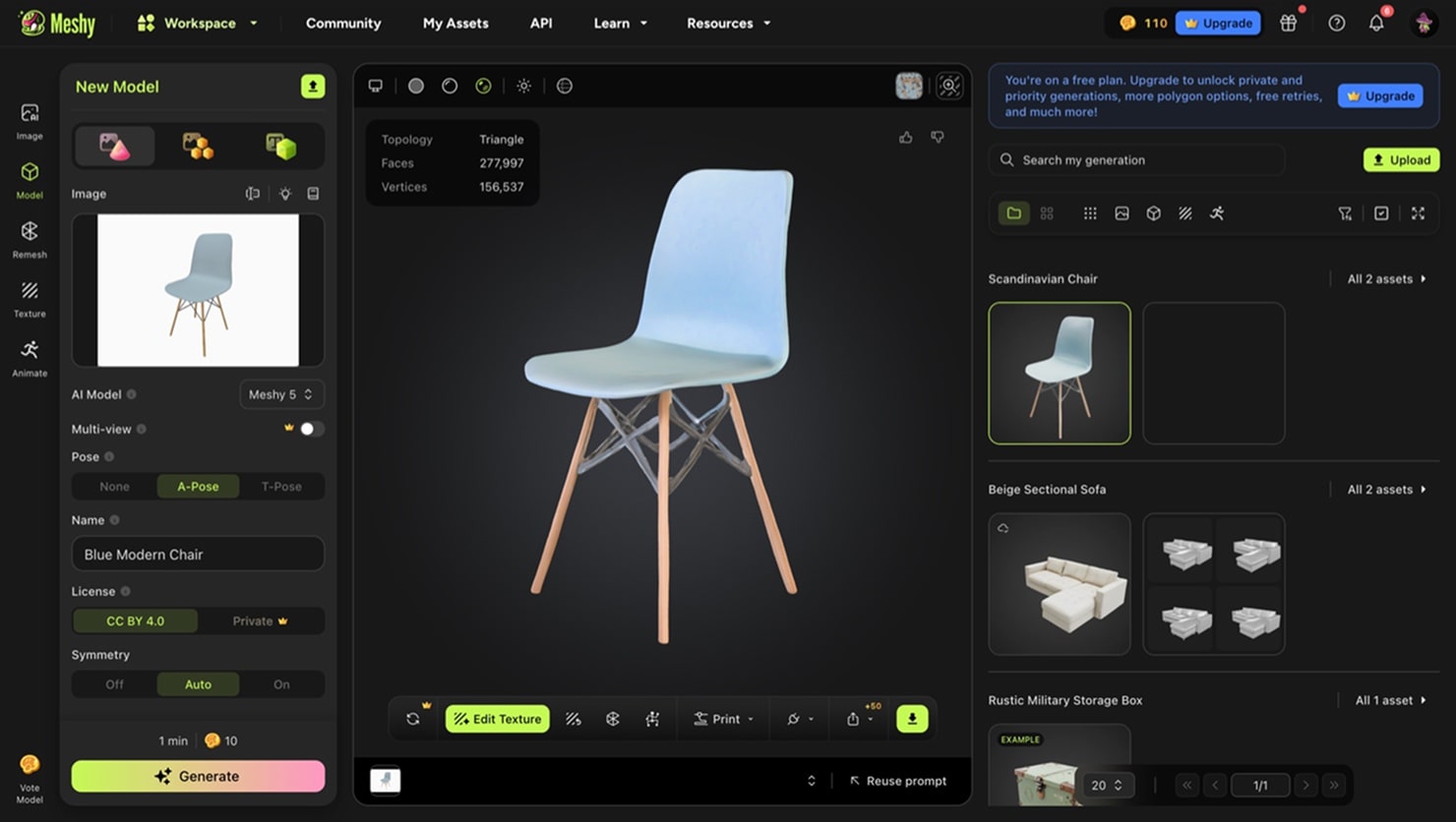
Meshy.ai focuses on empowering artists and non-artists alike to generate complete 3D models, including topology and PBR textures from simple text prompts or reference images. Its AI models analyze shape, volume, and material cues to output stylized or realistic assets within minutes. Multi-view image support improves accuracy by allowing users to upload several angles of an object.
Meshy’s key strengths lie in rapid concepting, prototyping, and generating base meshes that can be further refined in traditional software. It also offers AI-driven texturing, automatic rigging, and animation tools, making it a versatile option for game developers and 3D creators who want speed without sacrificing details quality.
Meshy offers a plug-in for most popular 3D modeling apps such as Blender, Maya, 3D Max, and others. As well as offers service of converting your own 3D models to other formats.
Highlights
- Generate: text to 3D, image to 3D, batch image to 3D.
- Export Formats: .fbx, .glb, .obj, .usdz, .blend, .stl, .3mf.
- Trial: Offers free plan and onboarding tasks to earn free credits.
Sloyd АІ
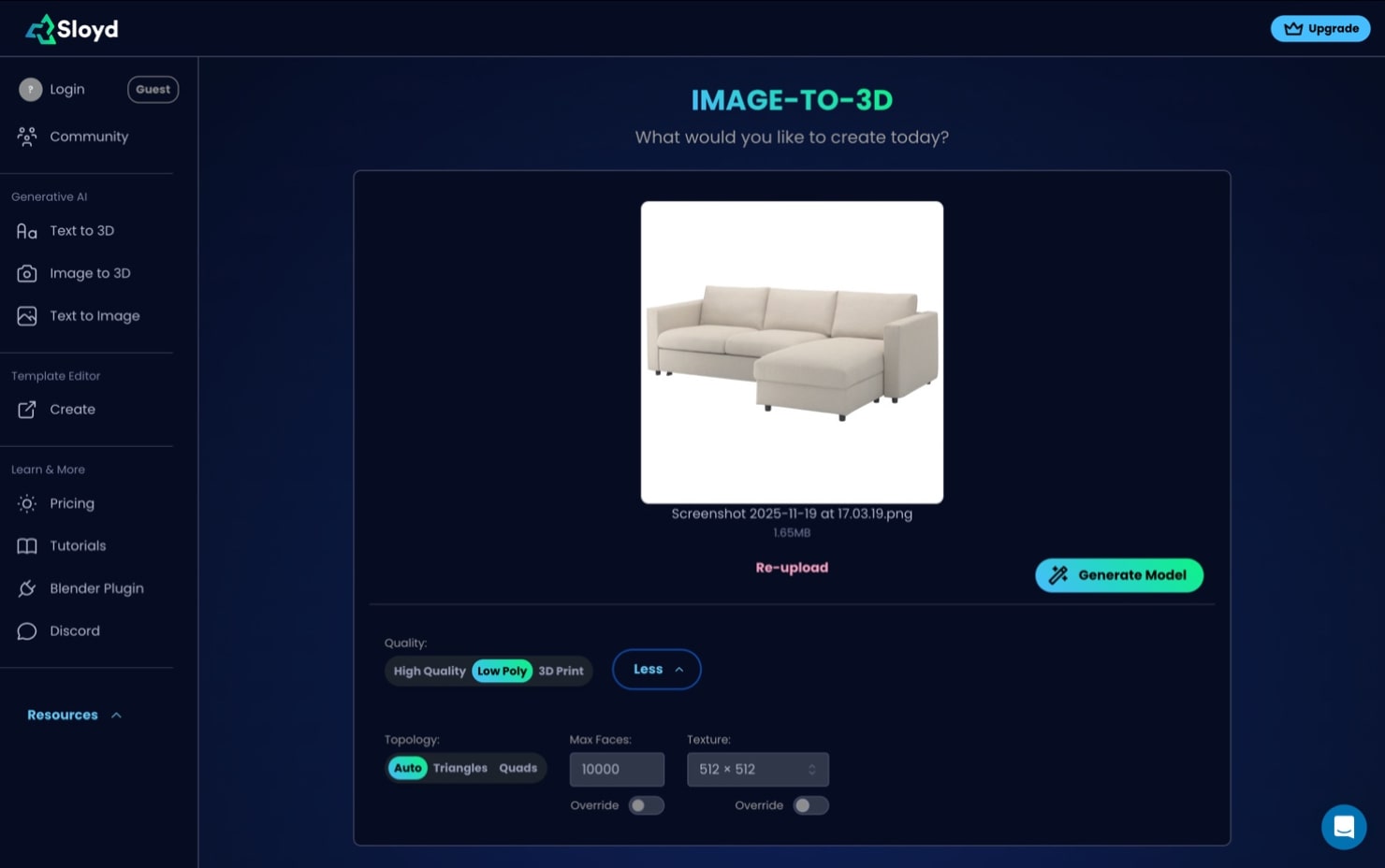
Sloyd.ai blends procedural modeling with AI intelligence. Instead of generating arbitrary geometry, Sloyd uses a library of parametric templates (characters, props, environment assets), then applies AI to customize, vary, and optimize them.
The AI evaluates shapes, proportions, and functional constraints (like poly count for real-time engines) to produce assets that maintain structural coherence. This approach gives users a high degree of control: sliders and parameters can adjust morphology, style, or complexity while the AI ensures everything remains functional and flawlessly modeled.
Highlights
- Generate: text to 3D, image to 3D, and text to image.
- Export Formats: .glb, .fbx, .obj, .usd, .usdz, and .blend.
- Trial: Free plan allows you to generate, but not download created 3D models.
Adobe Substance 3D
Substance’s AI doesn’t generate raw geometry, but it dramatically speeds up the surfacing stage, one of the most time-consuming parts of 3D modelling. The suite has quietly become one of the most impactful AI-assisted pipelines in the industry.
While Substance Designer and Painter remain artist-driven tools, Adobe has integrated AI in several significant ways.

Substance 3D Sampler
Adobe’s AI tool that lets you take a picture of a surface (wood, metal, fabric, concrete) and automatically generate tileable, high-quality PBR materials that can be used in 3D modeling.
Generative Texturing
AI-powered feature in Substance 3D that automatically creates, fills, and enhances textures based on text prompts or context from your 3D model. It helps fill, blend, and harmonize textures, predict mask regions, and automate tedious tasks like dirt/rust placement or ambient occlusion cleanup.
Smart Materials and Smart Masks
Smart Materials offer AI presets that automatically adapt to the shape and details of a 3D model, adding realistic layers of dust, scratches, rust, or wear based on geometry.
Smart Masks are context-aware masks that use AI to place effects only where they make sense (object edges, crevices, worn areas), saving time compared to manually masking details.
Spline
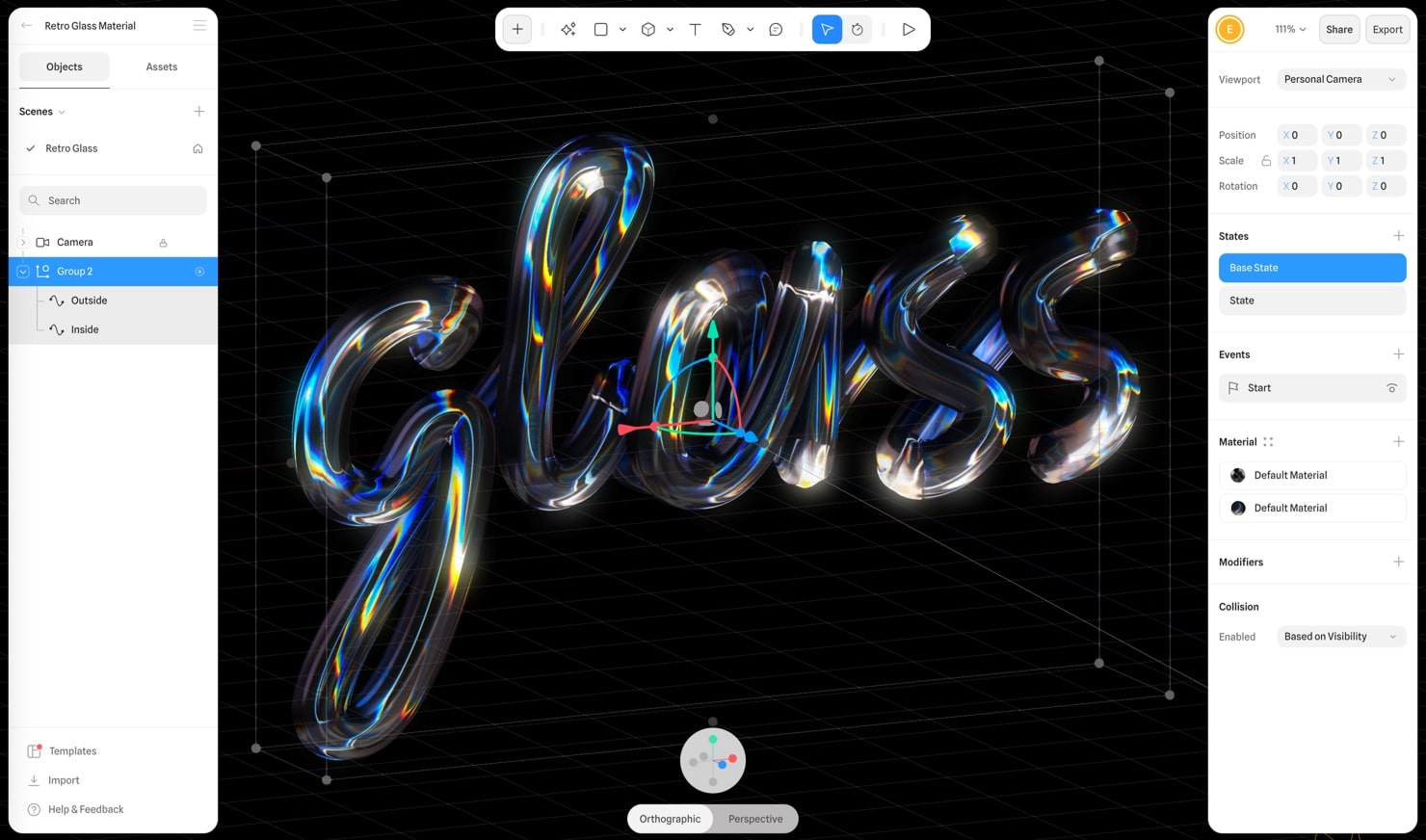
Spline is a browser-based 3D design tool that recently incorporated powerful AI features. Spline’s AI lowers the barrier for designers who want to add 3D elements to websites, apps, and product prototypes without becoming full 3D modelers.
Highlights
- Generate: text-to-3D, image-to-3D, and remix previously generated results.
- Export Formats: .glb/gltf, .usdz, or Three.js / React code.
- Trial: Free plan does not include AI tools.
Luma AI
Luma AI specializes in turning real-world objects and environments into high-fidelity 3D models using cutting-edge neural radiance fields (NeRF) and photogrammetry. Instead of generating models from text prompts, Luma’s approach relies on capturing video or photos of a real object, which its AI then reconstructs into detailed geometry and photorealistic textures.
Its core strength is realism: Luma excels at producing highly accurate meshes and materials that preserve subtle surface details, natural lighting, and complex shapes that are difficult to model manually. This makes it especially valuable for product visualization, digital twins, VFX, virtual environments, and AR/VR workflows where fidelity matters.
Beyond object capture, Luma offers features like background removal, automatic mesh cleanup, relighting, and environment scanning. Luma also has a mobile app for iOS, allowing users to create high-quality captures with nothing more than a smartphone.
Highlights
- Generate: video-to-3D, photo-to-3D, text to generative scenes.
- Export Formats: .glb, .usdz, .obj, and .fbx.
- Trial: Offers a free plan with usage limits.
Conclusion
AI doesn’t replace the artistry of 3D creation, it accelerates it. Instead of spending hours sculpting a base mesh or painting a material from scratch, artists can now start from high-quality AI-generated assets and focus their energy on refinements.
This shift is especially meaningful for applications that rely heavily on 3D objects. For example, users of interior design tools like Live Home 3D can now generate custom furniture and decor models on demand. With AI-powered services, virtually anyone, regardless of prior modeling experience, can design 3D furniture models seen in a store or a movie, and incorporate them into their dream interiors.

AI is not just speeding up workflows; it’s enabling a broader audience to participate in 3D design, making creativity more accessible than ever.